
We all know the regular expression character classes, right? There are 12 standard classes:
[:alnum:]  [:digit:]  [:punct:]
[:alpha:]  [:graph:]  [:space:]
[:blank:]  [:lower:]  [:upper:]
[:cntrl:]  [:print:]  [:xdigit:]
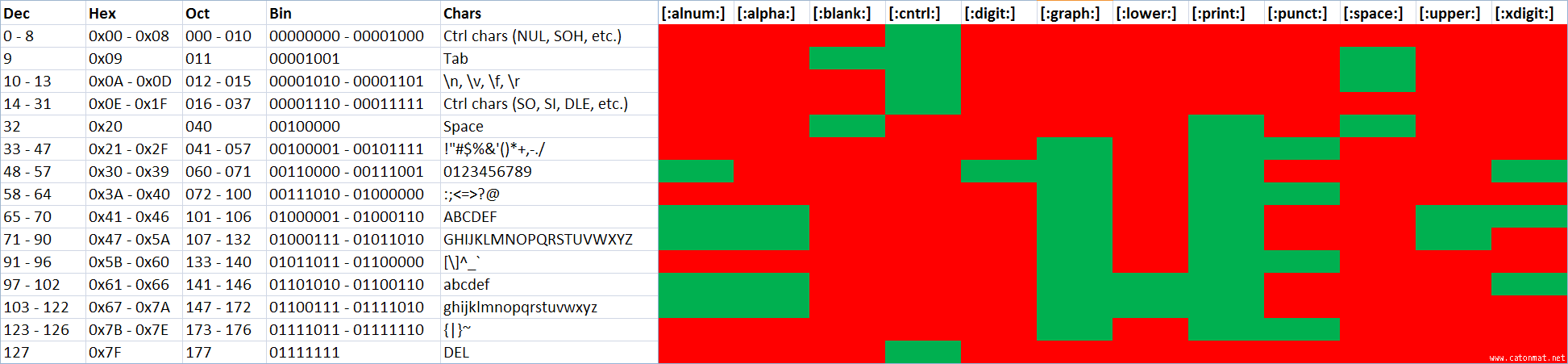
But have you seen a visual representation of what these classes match? Probably not. Therefore I created a visualization that illustrates which part of the ASCII set each character class matches. Call it a cheat sheet if you like:
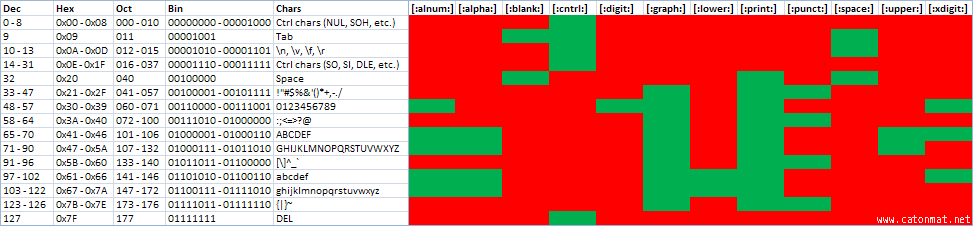 small version, large version
A bunch of programs that I used
Just for my own reference, in case I ever need them again, here are the one-liners I used to create this cheat sheet:
perl -nle 'printf "%08b - %08b\n", map { hex "0x".(split / /)[0], hex "0x".(split / /)[1] } $_ '
perl -nle 'printf "%03o - %03o\n", map { (split / /)[0], (split / /)[1] } $_'
And I used this perl program to generate and check the red/green matches:
use warnings;
use strict;

my $red = "\e[31m";
my $green = "\e[32m";
my $clear = "\e[0m";

my ($start, $end) = @ARGV;

die 'start or end not given' unless defined $start && defined $end;

my @classes = qw/alnum alpha blank cntrl digit graph lower print punct space upper xdigit/;

for (map { chr } $start..$end) {
    for my $class (@classes) {
        print "${green}1${clear}" if /[[:$class:]]/;
        print "${red}0${clear}" unless /[[:$class:]]/;
    }
    print "\n"
}
Credits
I was inspired to create this visualization when I saw a similar table for C's ctype.h character classification functions.